Alec Schmidt
Product Designer
Work
About
CV
Menu
Turning Progress Reports into an Organic Referral Engine
Juni Learning — January 2023
Juni Learning needed more customer referrals, but parents weren't sharing coupon codes. We discovered they were sharing their kids' projects, but not through us. We redesigned the weekly progress email to make that brag moment shareable.
Referral Conversion
11% → 24%
Signups via Referral
11% → 19%
Cost per Customer
$312 → $258
Problem Statement
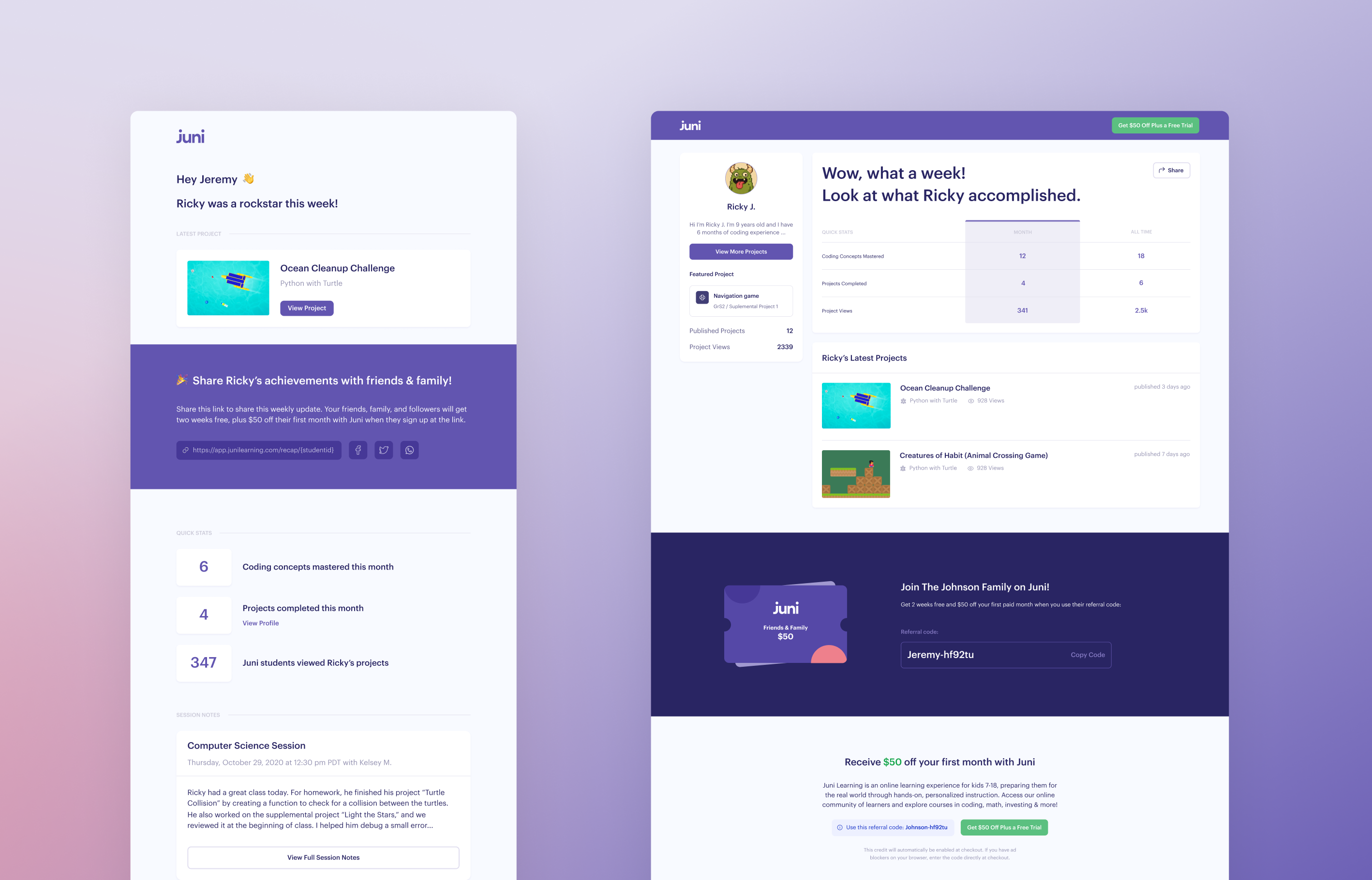
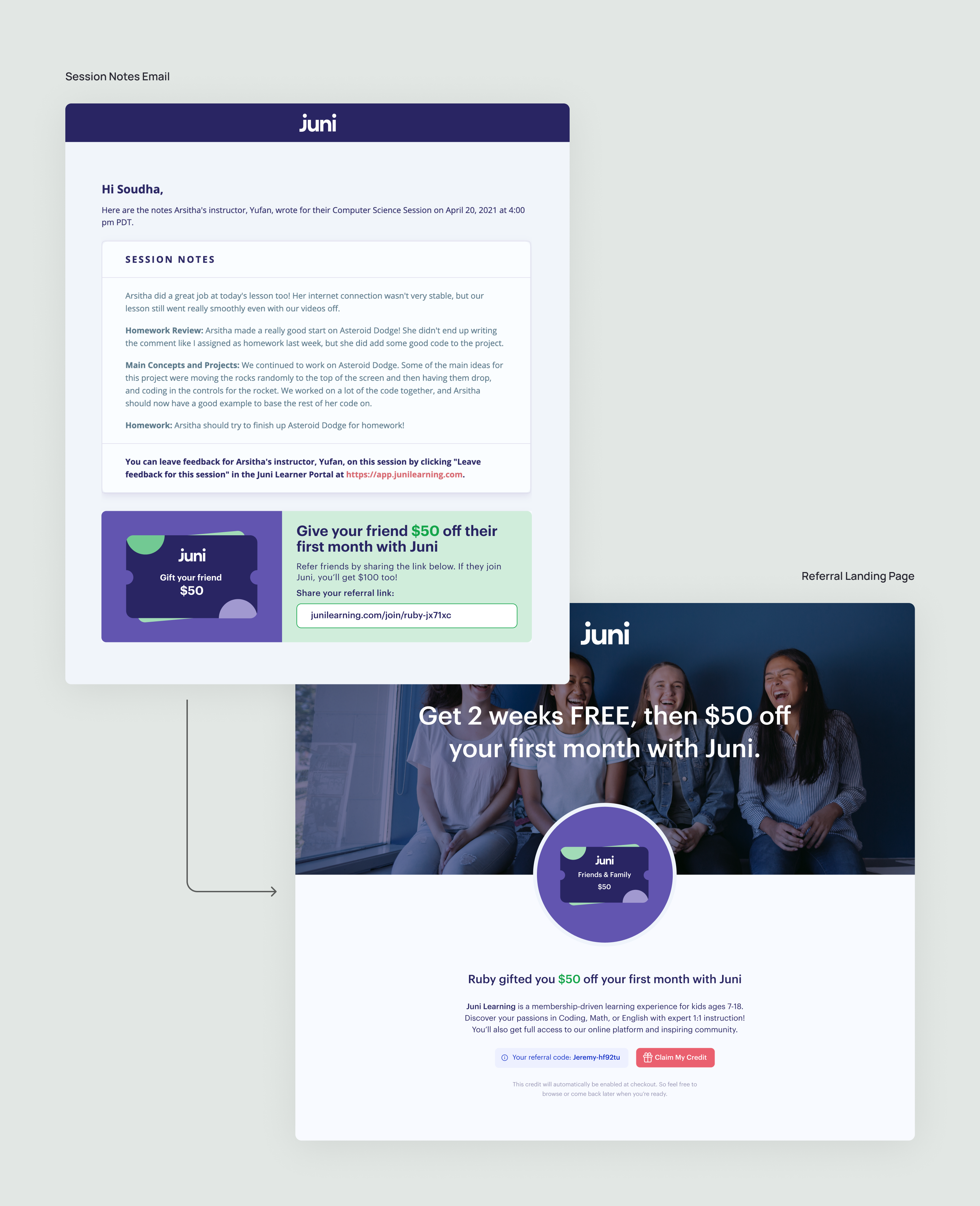
Juni Learning's referral rate was stuck at 11%. We were offering parents $50 off for friends, $100 off for themselves—and almost nobody shared.
Only 8% of parents ever used their referral code. In interviews, they called it "spammy" and "awkward."
Insight
We interviewed 6 parents and surveyed 127 more.
"I don't really share the referral code... it feels spammy. But when my daughter built that game where you catch the falling objects? I showed that to like five people at her soccer game."
8 out of 10 parents had informally shared their child's projects. Only 2 out of 10 had ever shared their coupon.
Parents share pride, not discounts.
Explorations
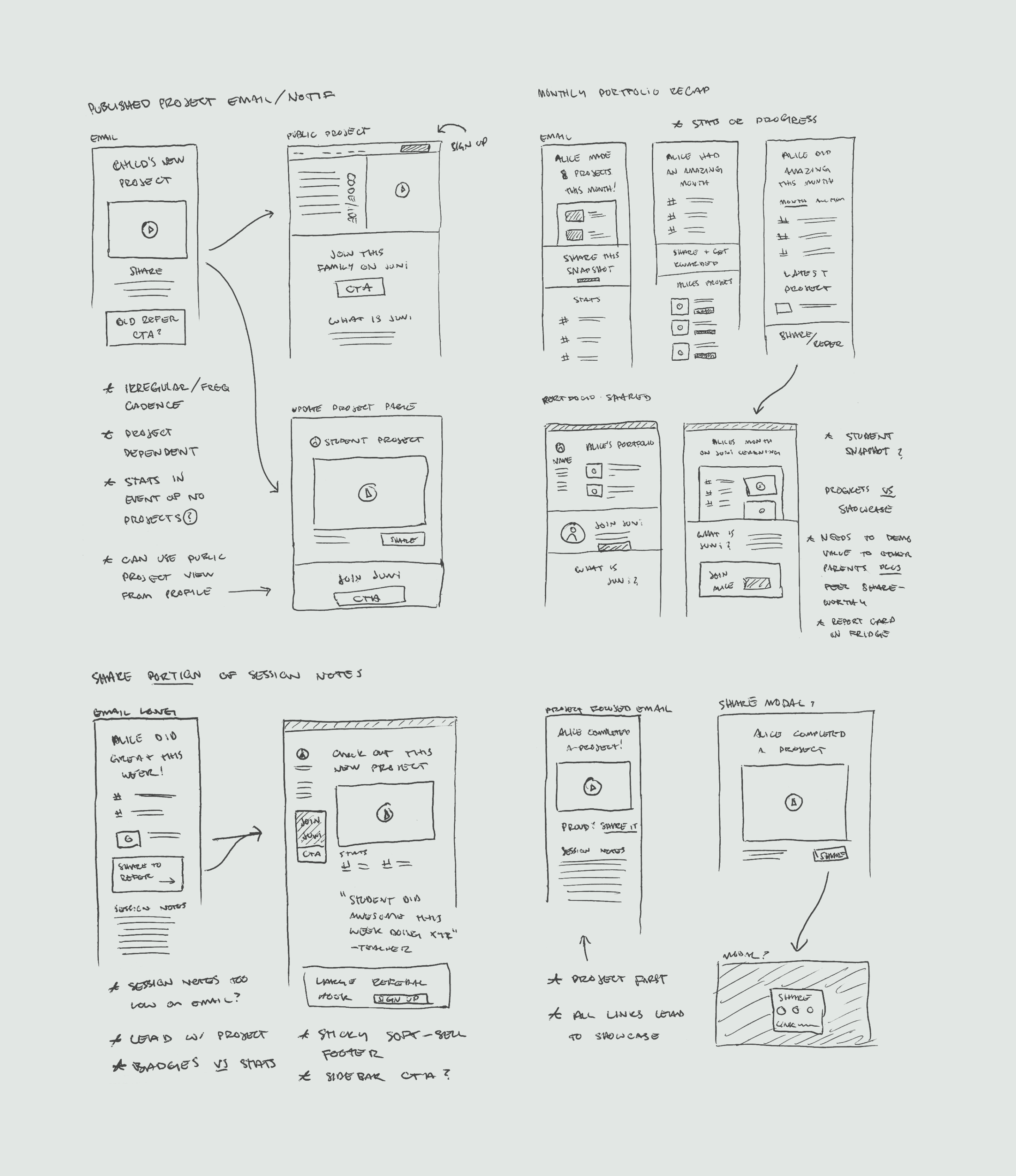
Parents were already showing off their kids' projects—just not through us. We explored ways to make that easier, given that the weekly session email was their only regular touchpoint with Juni.
Adding to Session Notes
We redesigned Session Notes (main parent touchpoint) in two layers:
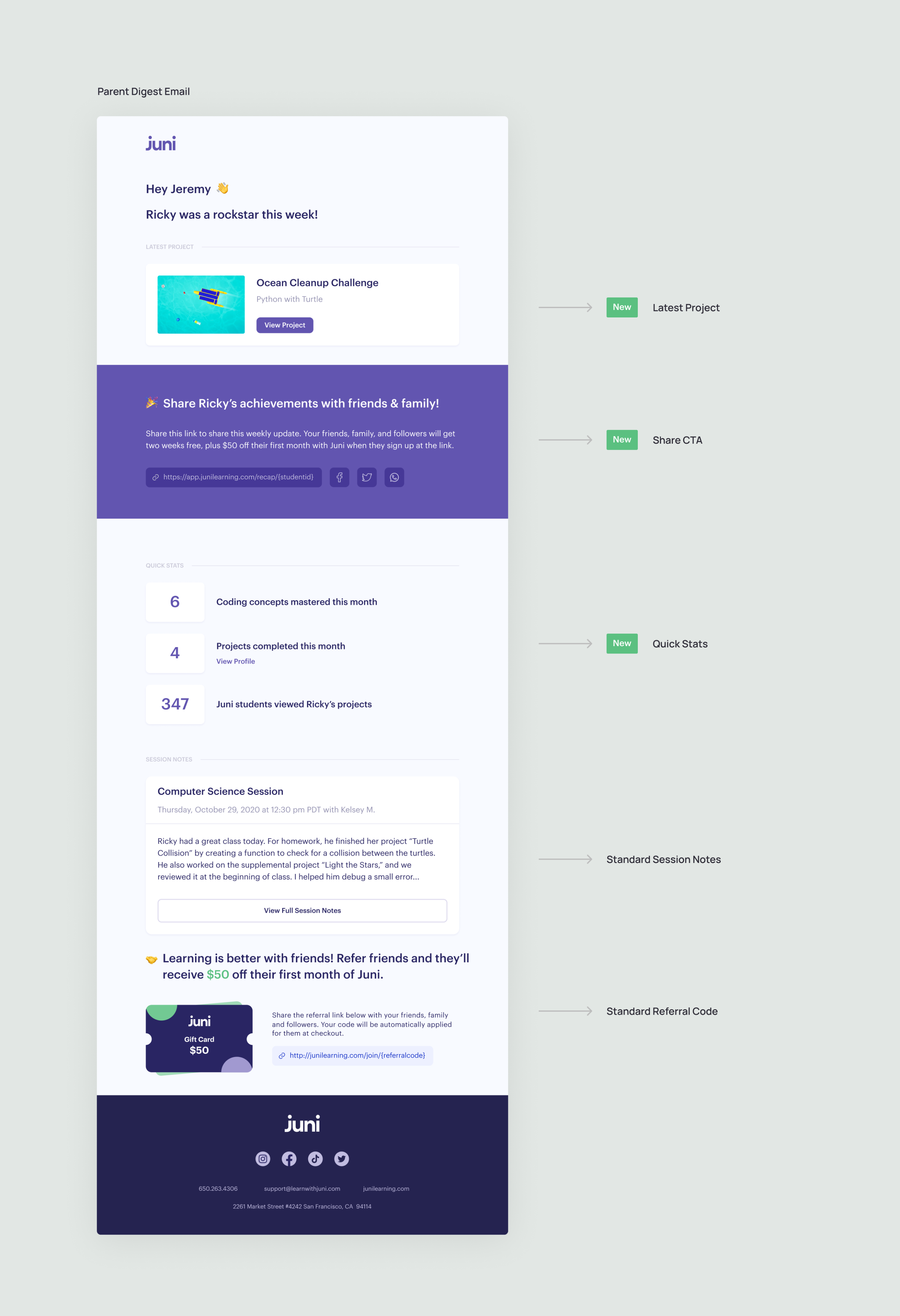
Parent Digest (email) A weekly email showcasing their child's latest project, quick stats, and instructor notes. The share CTA leads with "Share your child's progress" instead of "Refer a friend."
Creating a Student Showcase
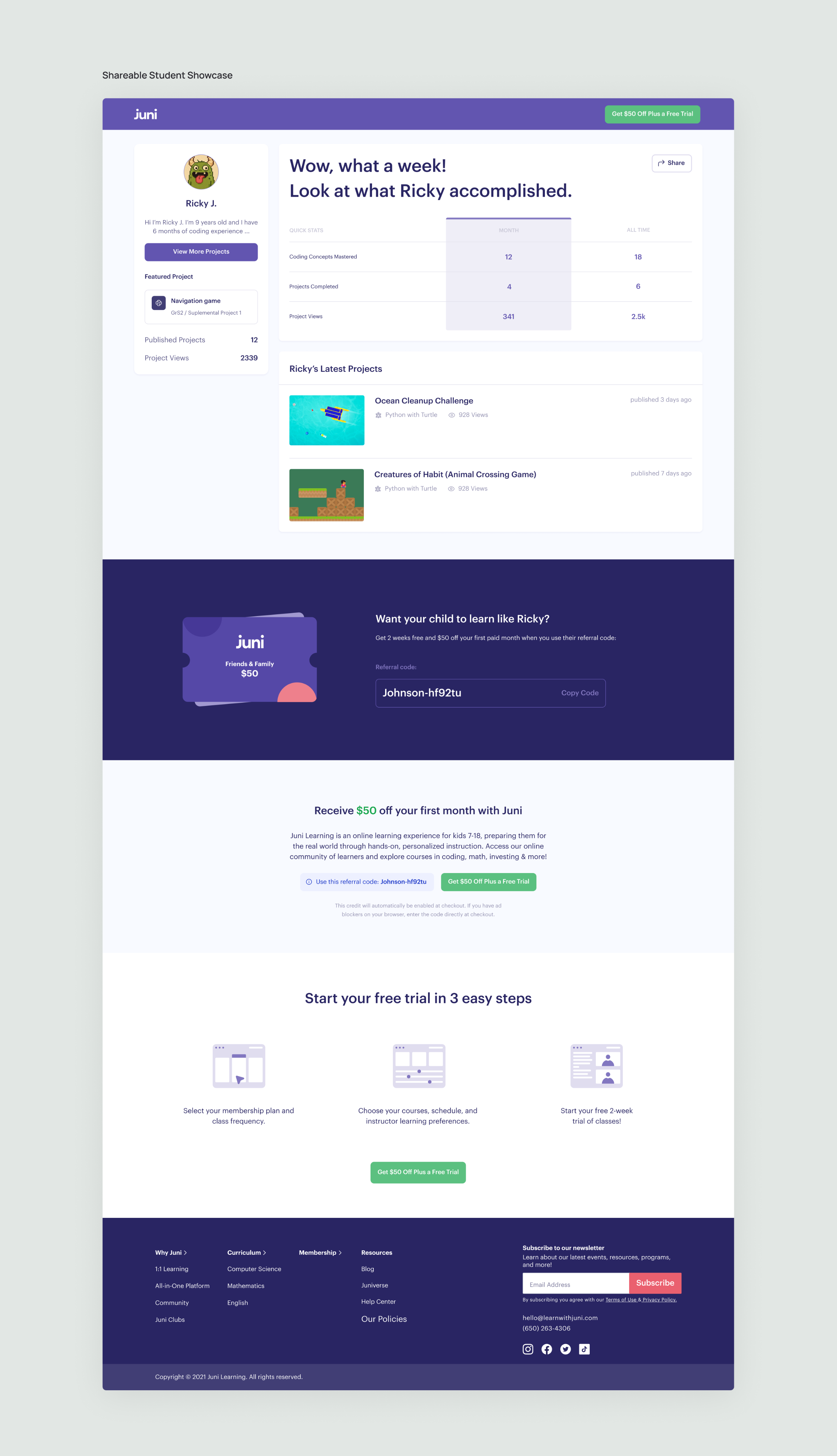
Student Showcase (what gets shared) A privacy-safe public page featuring recent projects and a soft referral CTA: "Want your child to learn like Ricky? Try Juni with this code."
The referral is embedded, not forced.
Design Decisions
Content hierarchy — Lead with the project (emotional), then stats (context), then instructor notes (depth). The thing parents are proudest of comes first.
Privacy-safe sharing — Worked with Legal to strip full names, session dates, and instructor details from the public version. Parents confirmed they'd happily share projects, skills, and milestones.
Soft sell positioning — The digest had to be valuable even if never shared. No "You haven't shared yet!" nudges. Referral CTAs stayed secondary in the visual hierarchy.
Growth Impact
Referral Conversion
11% → 24%
Signups via Referral
11% → 19%
Email Open Rate
31% → 52%
Sharing > Once (New)
28%
Parents Sharing (New)
34%
Cost per Customer
$312 → $258
What We Learned
Referrals work when they ride on genuine emotion. Designing for pride instead of transactions unlocked organic advocacy.
Recurrence is king. Traditional referral programs create one share moment. A weekly digest creates 52.
Utility first. The referral engine works because it’s valuable on its own.
Wanna build something together?
hello@alecschmidt.com

Alec Schmidt
Product Designer
Work
About
CV
Menu
Turning Progress Reports into an Organic Referral Engine
Juni Learning — January 2023
Juni Learning needed more customer referrals, but parents weren't sharing coupon codes. We discovered they were sharing their kids' projects, but not through us. We redesigned the weekly progress email to make that brag moment shareable.
Referral Conversion
11% → 24%
Signups via Referral
11% → 19%
Cost per Customer
$312 → $258
Problem Statement
Juni Learning's referral rate was stuck at 11%. We were offering parents $50 off for friends, $100 off for themselves—and almost nobody shared.
Only 8% of parents ever used their referral code. In interviews, they called it "spammy" and "awkward."
Insight
We interviewed 6 parents and surveyed 127 more.
"I don't really share the referral code... it feels spammy. But when my daughter built that game where you catch the falling objects? I showed that to like five people at her soccer game."
8 out of 10 parents had informally shared their child's projects. Only 2 out of 10 had ever shared their coupon.
Parents share pride, not discounts.
Explorations
Parents were already showing off their kids' projects—just not through us. We explored ways to make that easier, given that the weekly session email was their only regular touchpoint with Juni.
Adding to Session Notes
We redesigned Session Notes (main parent touchpoint) in two layers:
Parent Digest (email) A weekly email showcasing their child's latest project, quick stats, and instructor notes. The share CTA leads with "Share your child's progress" instead of "Refer a friend."
Creating a Student Showcase
Student Showcase (what gets shared) A privacy-safe public page featuring recent projects and a soft referral CTA: "Want your child to learn like Ricky? Try Juni with this code."
The referral is embedded, not forced.
Design Decisions
Content hierarchy — Lead with the project (emotional), then stats (context), then instructor notes (depth). The thing parents are proudest of comes first.
Privacy-safe sharing — Worked with Legal to strip full names, session dates, and instructor details from the public version. Parents confirmed they'd happily share projects, skills, and milestones.
Soft sell positioning — The digest had to be valuable even if never shared. No "You haven't shared yet!" nudges. Referral CTAs stayed secondary in the visual hierarchy.
Growth Impact
Referral Conversion
11% → 24%
Signups via Referral
11% → 19%
Email Open Rate
31% → 52%
Sharing > Once (New)
28%
Parents Sharing (New)
34%
Cost per Customer
$312 → $258
What We Learned
Referrals work when they ride on genuine emotion. Designing for pride instead of transactions unlocked organic advocacy.
Recurrence is king. Traditional referral programs create one share moment. A weekly digest creates 52.
Utility first. The referral engine works because it’s valuable on its own.
Wanna build something together?
hello@alecschmidt.com
Turning Progress Reports into an Organic Referral Engine
Juni Learning — January 2023
Juni Learning needed more customer referrals, but parents weren't sharing coupon codes. We discovered they were sharing their kids' projects, but not through us. We redesigned the weekly progress email to make that brag moment shareable.
Referral Conversion
11% → 24%
Signups via Referral
11% → 19%
Cost per Customer
$312 → $258
Problem Statement
Juni Learning's referral rate was stuck at 11%. We were offering parents $50 off for friends, $100 off for themselves—and almost nobody shared.
Only 8% of parents ever used their referral code. In interviews, they called it "spammy" and "awkward."
Insight
We interviewed 6 parents and surveyed 127 more.
"I don't really share the referral code... it feels spammy. But when my daughter built that game where you catch the falling objects? I showed that to like five people at her soccer game."
8 out of 10 parents had informally shared their child's projects. Only 2 out of 10 had ever shared their coupon.
Parents share pride, not discounts.
Explorations
Parents were already showing off their kids' projects—just not through us. We explored ways to make that easier, given that the weekly session email was their only regular touchpoint with Juni.
Adding to Session Notes
We redesigned Session Notes (main parent touchpoint) in two layers:
Parent Digest (email) A weekly email showcasing their child's latest project, quick stats, and instructor notes. The share CTA leads with "Share your child's progress" instead of "Refer a friend."
Creating a Student Showcase
Student Showcase (what gets shared) A privacy-safe public page featuring recent projects and a soft referral CTA: "Want your child to learn like Ricky? Try Juni with this code."
The referral is embedded, not forced.
Design Decisions
Content hierarchy — Lead with the project (emotional), then stats (context), then instructor notes (depth). The thing parents are proudest of comes first.
Privacy-safe sharing — Worked with Legal to strip full names, session dates, and instructor details from the public version. Parents confirmed they'd happily share projects, skills, and milestones.
Soft sell positioning — The digest had to be valuable even if never shared. No "You haven't shared yet!" nudges. Referral CTAs stayed secondary in the visual hierarchy.
Growth Impact
Referral Conversion
11% → 24%
Signups via Referral
11% → 19%
Cost per Customer
$312 → $258
Email Open Rate
31% → 52%
Parents Sharing (New)
34%
Sharing > Once (New)
28%
What We Learned
Referrals work when they ride on genuine emotion. Designing for pride instead of transactions unlocked organic advocacy.
Recurrence is king. Traditional referral programs create one share moment. A weekly digest creates 52.
Utility first. The referral engine works because it’s valuable on its own.
Wanna build something together?
hello@alecschmidt.com